
Index of this post
Published in English translation
Published in French
Notes – Julia Evans (August 2026)
Missing diagram
Information on Session 19th June 1968 & its Mathemes (Lutecium)
Introductory paragraph to November 1985 publication with Richard G. Klein’s note (August 2026)
Jacques Lacan’s References
Reference to ‘the unconscious is structured as a language’
Commentary
Citations
Related text
***
Published in English translation
***
– Translated from unedited tape transcriptions by Cormac Gallagher
Annex I, 19th June 1968, p1-11 of http://www.LacaninIreland.com /Translations /Seminars (Seminar XV/15)
***
Published bilingual
***
– Translated from Bulletin de l’Association freudienne n° 35, pp.3-9, November 1985 by Anthony Chadwick, edited by Richard G. Klein,
Available bilingual www.Freud2Lacan.com /Lacan (178. The last session of Lacan’s Seminar XV, The Psychoanalytic Act–1968, June 19th)
***
Published in French
***
-Direct transcription from tapes or the stenotypes
1) Séminaire XV : L’Acte Psychanalytique : 1967-1968 : Jacques Lacan, available at http://staferla.free.fr /Séminaire 15.
Conférence du mercredi 19 juin 1968 (E.L.P.) http://staferla.free.fr/S15/S15%20L’ACTE.pdf
This document is updated when new information is acquired.
The main sources for this working paper are:
*The Psychoanalytic Act*, critical edition by the E.L.P. (which forms the basis of this work), available on the E.L.P. website. [École lacanienne de psychanalyse – see below]
*The Psychoanalytic Act*, stenographic transcript in PDF format, available on the E.L.P. website.
2) Original stenotype with corrections.
École lacanienne de psychanalyse https://ecole-lacanienne.net/ LACAN BIBLIOTHÈQUE
/ Séminaires – Jacques Lacan – Versions J.L. et non J.L.
/ 1967-1968 : L’ACTE PSYCHANALYTIQUE-VERSION J.L.
/ 19 juin 1968, https://ecole-lacanienne.net/wp-content/uploads/2016/04/1968.06.19.pdf
3) From stenotypes https://www.lutecium.org/1968/06#gsc.tab=0
Collected by the École lacanienne de psychanalyse
Original stenograph https://www.lutecium.org/Jacques_Lacan/Media/pdf/1968.06.19-15-lacte.pdf
As published https://www.lutecium.org/Jacques_Lacan/Media/pdf/1968.06.19-15-lacteA.pdf
-Collected by aejcpp [http://aejcpp.free.fr/biblio.htm ]
As published in the Bulletin de l’Association freudienne n° 35, pp.3-9, November 1985 (after Lacan’s death) https://www.lutecium.org/mirror/aejcpp.free.fr/lacan/1968-06-19.htm
4) Published edited by Jacques-Alain Miller (2024)
Jacques Lacan, Le Séminaire livre XV, L’Acte psychanalytique, Texte établi par Jacques-Alain Miller : Seuil & Le Champ Freudien (9th February 2024)
***
Notes – Julia Evans
***
The two translations are similar so from similar sources. For impact and immediacy, I prefer Cormac Gallagher’s which is from transcriptions of tapes rather than the published version.
You are advised to consult
- i) Richard Klein’s notes, Freud2Lacan.com
- ii) and the footnotes which are updated with new information regularly, at http://staferla.free.fr/S15/S15%20L’ACTE.pdf.
***
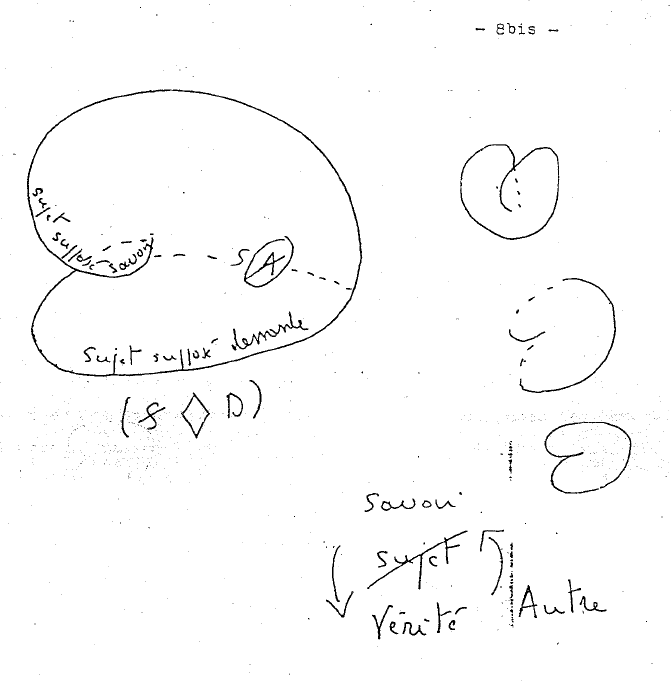
Missing diagram
***
iii) On p8 (bis) of the original stenograph https://www.lutecium.org/Jacques_Lacan/Media/pdf/1968.06.19-15-lacte.pdf is the diagram
missing from p5 of www.Freud2Lacan.com
& missing from Annex 1 p3 of www.LacaninIreland.com.
There is a diagram on p166 of Staferla, which in August 2026 does not match ELP’s.
P8bis of ELP, https://ecole-lacanienne.net/wp-content/uploads/2016/04/1968.06.19.pdf
***
Information on Session 19th June 1968 & its Mayhems
***
From Topologos Lutecium, Les Mathèmes de Lacan, Recherche, Table des Matières, de Jacques B. Siboni
See https://www.lutecium.org/mathemes/lacan_sem.html for index of Jacques Lacan’s mathemes
For 19th June 1968, https://www.lutecium.org/mathemes/node472.html
Mathemes
Jacques Lacan’s Mathemes
Here is the English translation via the internet of a Mathematics Thesaurus taken from written texts and from Dr. Lacan. It covers all the texts written by Lacan and all the seminars he held in 1953 at 1979. Accompanying this thesaurus, there is a search tool allowing to visualise the citations comprising one or more mathemes, these appearing in chronological order.
A Mathematics Thesaurus for 19th June 1968
Translated via the internet and reproduced without the links given on the site
15.18 Je suis pas un truqueur …, 19 juin 1968
15.18 I’m Not a Cheat …, June 19, 1968
Points derived from the text [Lac68f, June 19, 1968]
The Other is the place where speech takes root.
* All knowledge comes to us from the Other.
* There is always an Other where tradition, accumulation, and the reservoir reside.
* Me the truth, I am speaking. [Moi la vérité, je parle].
* Me the truth, I am speaking. [Moi la vérité, je parle].
* Me the truth, I am speaking. [Moi la vérité, je parle].
* The unconscious is structured as a language.
Since the subject is secondary to knowledge, it does not say everything it knows.
The subject does not know everything they say.
The subject, from being second through relationship to knowledge [d’être second par rapport au savoir], does not say everything that he knows.
The subject does not know everything he says.
The truth lies at the point where the subject refuses to know.
* Everything that is rejected from the symbolic reappears in the real.
* The symptom is that real knot where the subject’s truth lies.
* It is only at the level of the Other that what determines the subject takes the form of knowledge.
The analyst, through his offer, creates demand.
* The subject does not know what he is asking for.
***
Introductory paragraph to November 1985 publication with Richard G. Klein’s note (August 2026)
***
Opening paragraph,
(Translation) The “Talk from Wednesday the 19th of June 1968” was published in the Bulletin de l’Association freudienne n° 35, pp.3-9 in November 1985 with the following comment: “During his work on the Analytical act during the summer week in 1989, Claude Dorgeuille brought to light and commented on a little-known talk by Jacques Lacan on the 19th of June 1968 […]”*
*(Richard G. Klein notes) Seminar XV, L’acte psychanalytique, 1967-1968. The last session was May 17, 1968. A month later, Lacan had an additional session on Wednesday, June 19th, 1968.
The timeframe of this specific session is vital. Seminar XV was severely disrupted and cut short by the student strikes and civil unrest of May 18, 1968 in Paris. Because of the political upheaval, Lacan only delivered about half of what he originally planned to articulate regarding the analytic act.
***
Jacques Lacan’s References
***
Annex I – Session of 19th June 1968
19.6.68 p7 of Cormac Gallagher’s translation : To this relation of the subject to the Other, psychoanalysis contributes a radically new dimension. It is more than what I called just now, called just now, like that, a discovery. A discovery still preserves something anecdotal about. This is a profound modification of the whole relationship.
There is a word that I brought in here a few years ago, into this dialectic. It is the word truth. And then, in truth, before articulating it precisely as I did here on a particular day, the perfectly logical mark of the article Truth and Science[i], in my Écrits bears witness to, I had given to the word another function, in an article called The Freudian Things[ii], where one can read these terms: ‘Me, the truth, I speak.’ [Moi, la verité, je parle]
Who? The I that is speaking? This piece, in truth a prosopopoeia[iii], one of these Enthusiastic games that I happened to allow myself to articulate for the centenary of (302) Freud[iv], and at Vienna. It was rather a scream of the order of what Münch[v] put so well into a celebrated engraving, this twisted mouth in which we see arising the sublime annihilation of a whole landscape.
Footnotes
NOTE, Footnotes for this quote 19th June 1968,
Science and Truth 1st December 1965, The Freudian Thing 7th November 1955, Civilisation and its Discontents 1929, Mass Psychology 1921.
A probably vain attempt has been made to indicate to which text the footnotes refer! Two of Freud’s texts also have modified translations.
JE August 2026.
***
[i] 19.6.1968, See Seminar XIII- Science & Truth : 1st December 1965 : Jacques Lacan. See this site /4 Jacques Lacan (19651201 or Index of Jacques Lacan’s texts)
Possibly, p24-25 of Bruce Fink’s translation, (this is the end of the session), Need it be said that in science, as opposed to magic and religion, knowledge is communicated?
It must be stressed that this is not merely because it is usually done, but because the logical form given this knowledge includes a mode of communication which sutures the subject knowledge implies.
That is the main problem raised by communication in psychoanalysis. The first obstacle to its scientific value is that the relation to truth as cause, in its material guises, has remained neglected by the circle of its elaborators.
Shall I conclude in returning to the point with which I began today: the division of the subject? This point constitutes a knot.
Let us recall that Freud unties the knot in his discussion of the lack of the mother’s penis, where the nature of the phallus is revealed. He tells us that the subject divides here regarding reality, seeing an abyss opening up therein against which he protects himself with a phobia, and which he at the same time covers over with a surface upon which he erects a fetish, i.e. the existence of the penis maintained albeit displaced.
Let us, on the one hand, extract the (no) [pas-de] from the (no-penis) [pas-de-penis], to be bracketed out [a mettre entre parentheses], and transfer it to the no-knowledge [pas-de-savoir] that is the hesitation step [pas-hesitation] of neurosis [48]
Let us, on the other hand, recognise the subject’s efficacity in the gnomon he erects, a gnomon that constantly indicates truth’s site[49] to him.
Revealing that the phallus itself is nothing but the site of lack it indicates in the subject.
This is the same index that directs me to the path along which I want to proceed this year, i.e. the path away from which you· yourselves shy, as you are called forth as analysts in that lack.
(Bruce Fink’s translator note 1.12.1965) [48] “pas” in French can mean both “no” (or “not”) and “step”.
(Bruce Fink’s translator notes 1.12.1965) [49] “le point de vérité:” the point, place or position of truth: “site of lack” in the next sentence corresponds to “ce point de manque”. I have translated “à toute heure” by “constantly”, but the combination in French of something being erected that at every moment or hour designates the place of something else could be taken to have sundial overtones. Lacan is here playing off the expression “l’heure de vérité” the moment of truth in writing “à toute heure le point de vérité”
***
[ii] 19.6.1968, See The Freudian Thing or the Meaning of the Return to Freud in Psychoanalysis : 7th November 1955 (Vienna) : Jacques Lacan at this site /4 Jacques Lacan (19551107 or Index of Jacques Lacan’s texts)
Lacan, (this text-see above) ‘where one can read these terms: ‘Me, the truth, I speak.’
P125 of Alan Sheridan’s translation Freudian Thing, One began only to repeat after Freud the word of his discovery: it [id (ça)] speaks,[a] and, no doubt, where it is least expected, namely, where there is pain. If there ever was a time when simply listening to what it said was sufficient reply (for hearing it is already a reply), let us suppose therefore that the great ones of the early days, the arm-chair giants, were struck by the curse destined to titanic acts of daring, or that their seats ceased to be conductors of the good speech before which they were expected to sit. However, since then, the meetings between the psychoanalyst and psychoanalysis have increased in the hope that the Athenian could be reached with Athene having emerged fully armed from the head of Freud. Shall I tell you of the jealous fate, ever the same, that thwarted these meetings: beneath the mask in which everyone was to meet his promised, alas! thrice alas! and a cry of horror at the thought of it, another having taken her place, he who was there was not he either.
Let us return, then, quite deliberately, and with the truth spell out what it has said of itself. The truth has said: ‘I speak’. To recognize this ‘I’ by what he speaks, perhaps we should not have turned to the ‘I’, but paused at the angle of intersection of the speech. ‘There is no speech that is not language'[b] reminds us that language is an order constituted by laws, of which we might at least learn what they exclude. For example, that language is different from natural expression and that it is not a code either; that it is not to be confused with information – and don’t forget it when you are dealing with cybernetics; and that it is so irreducible to a superstructure that materialism itself is seen to be alarmed by this heresy – see Stalin’s bull[c] on the question.
***
[a] [JE Freudian Thing], This probably should be ‘id speaks’ and not ‘it speaks’.
For further on Lacan’s ‘Who? The I that is speaking?’ & ‘Me, the truth, I speak.’ (this text),
See Civilisation and its Discontents : 1929 : Sigmund Freud, SE XXI p58-145, see this site /3 Sigmund Freud (19290101 or Index of Sigmund Freud’s texts)
Section VI, SE XXI p117-118, (includes suggested modifications of the translation – JE) We shall see, however, that this is not so and that it is merely a matter of bringing into sharper focus a tum of thought arrived at long ago and of following out its consequences. Of all the slowly developed parts of analytic theory, the theory of the drives [not instincts – die Trieblehre] is the one that has felt its way the most painfully forward.[1] And yet that theory was so indispensable to the whole structure that something had to be put in its place. In what was at first my utter perplexity, I took as my starting-point a saying of the poet-philosopher, Schiller, that ‘hunger and love are what moves the world’. [2] [Internet translation], Hunger could be regarded as representative of those drives that seek to preserve the individual, whereas love strives towards objects; its primary function—favoured by nature in every respect—is the preservation of the species. …
[German, Der Hunger konnte als Vertreter jener Triebe gelten, die das Einzelwesen erhalten wollen, die Liebe strebt nach Objekten; ihre Hauptfunktion, von der Natur in jeder Weise begiinstigt, ist die Erhaltung der Art].
[Strachey, Hunger could be taken to represent the instincts which aim at preserving the individual; while love strives after objects, and its chief function, favoured in every way by nature, is the preservation of the species. Thus, to begin with, ego-instincts and object-instincts confronted each other.]
… It was to denote the energy of the latter and only the latter drives [not instincts – Trieben] that I introduced the term ‘libido’.[3] [Internet translation] Thus, the opposition played out between the ego-drives and the object-directed “libidinal” drives of love in the broadest sense.[4] …
[Original German, somit lief der Gegensatz zwischen den Ichtrieben und den aufs Objekt gerichteten »libidinosen« Trieben der Liebe[4] im weitesten Sinne] [Strachey’s translation, Thus the antithesis was between the ego-instincts and the ‘libidinal’ instincts of love (in its widest sense [4]) which were directed to an object].
… One of these object-drives [not instincts], the sadistic one [not instinct][ Einer von diesen Objekttrieben, der sadistische], stood out from the rest, it is true, in that its aim was so very far from being loving. Moreover it was obviously in some respects attached to the ego-drives [not instincts (Ichtrieben)]: could not hide its close affinity [internet translation] with drives for mastery, devoid of libidinal (elements or intent). …
[Original German, konnte seine nahe Verwandtschaft mit Bemachtigungstrieben ohne libidinose] [Strachey, instincts of mastery which have no libidinal purpose].
… But these discrepancies were got over; after all, sadism was clearly a part of (end of SE III p117-beginning p118) sexual life, in the activities of which affection could be replaced by cruelty. Neurosis was regarded as the outcome of a struggle between the interest of self-preservation and the demands of the libido, a struggle in which the ego had been victorious but at the price of severe sufferings and renunciations.
[1] [Civilisation, James Strachey notes] [Some account of the history of Freud’s theory of the instincts will be found in the Editor’s Note to his paper ‘Instincts and their Vicissitudes’ (1915c), Standard Ed., 14, 113 ff.]
See Drives (mistranslated as Instincts) and their vicissitudes : 1915c : Sigmund Freud, Triebe und Triebschicksale. Internationale Zeitschrift für (ärztliche) Psychoanalyse, III, p. 84-100; G.W., X, p. 210-232; SE XIV p117-140 at this site /3 Sigmund Freud (19150101 or Index of Sigmund Freud’s texts)
[2] [Civilisation, James Strachey notes] [‘Die Weltweisen.’] [3] [Civilisation, James Strachey notes] [In Section II of the first paper on anxiety neurosis (1895b).]
See Section II INCIDENCE AND AETIOLOGY, SE III p102-106 of Grounds for Detaching a Particular Syndrome from Neurasthenia under the Description “Angst (Anxiety) Neurosis’ : June 1894 [1895b] : Sigmund Freud [Uber die Berechtigung von der Neurasthenie einen Bestimmten Symptpmenkomplex als “Angstneurose” Abzutrennen], SE III p85-115, Notes, availability & citations this site /3 Sigmund Freud (18940601).
Note : The problems with the James Strachey translation are explored in, Angst translated as Anxiety in Sigmund Freud’s texts : 26th February 2025 : Julia Evans, see this site /Authors A-Z (Evans)
[4] [Civilisation, James Strachey notes] [i.e. as used by Plato. See Chapter IV of Group Psychology (1921c), Standard Ed., 18, 99.]
See Mass (mistranslated as Group) Psychology and the Analysis of the Ego : 1921 [1922] : Sigmund Freud, SE XVIII p69-143. [ Massenpsychologie und Ich-analyse] on this site /3 Sigmund Freud (19210101 or Index of Sigmund Freud’s texts).
SE XVIII p91 (translation has been modified JE), We are of opinion, then, that language has carried out an entirely justifiable piece of unification in creating the word ‘love’ with its numerous uses, and that we cannot do better than take it as the basis of our scientific discussions and expositions as well. By coming to this decision, psychoanalysis has let loose a storm of indignation, as though it had been guilty of an act of outrageous innovation. Yet it has done nothing original in taking love in this ‘wider’ sense. [Internet translation] The “Eros” of the philosopher Plato, in its origin, achievement, and relationship to sexual love, shows a complete correspondence with the power of love, the libido of psychoanalysis, …
[James Strachey, In its origin, function, and relation to sexual love, the ‘Eros’ of the philosopher Plato coincides exactly with the love-force, the libido of psychoanalysis,] [German, Der »Eros« des Philosophen Plato zeigt in seiner Herkunft, Leistung und Beziehung zur Geschlechtsliebe eine vollkommene Deckung mit der Liebeskraft, der Libido der Psychoanalyse, ]
… as has been shown in detail by Nachansohn (1915) and Pfister ( 1921) ; and when the apostle Paul, in his famous epistle to the Corinthians, praises love above all else, he certainly understands it in the same ‘wider’ sense.[1] But this only shows that men do not always take their great thinkers seriously, even when they profess most to admire them. [Internet translation] In psychoanalysis, these love-drives are now termed sexual drives a potiori [i] and on the basis of their origin.
[German] Diese Liebestriebe werden nun in der Psychoanalyse a potiori [i] und von ihrer Herkunft her Sexualtriebe geheiBen.
[James Strachey translates] Psychoanalysis, then, gives these love instincts the name of sexual instincts, a potiori[i] and by reason of their origin.
NACHANSOHN, M. (1915) ‘Freuds Libidotheorie verglichen mit der Eroslehre Platos’, Int. Z. ärztl. Psychoanal., 3, 65.
PFISTER, O. (1921) ‘Plato als Vorläufer der Psychoanakyse’, Int. Z. Psychoanal., 7, 264
[1] [Mass Psychology, James Strachey footnote] ‘Though I speak with the tongues of men and of angels, and have not charity [love], I am become as sounding brass, or a tinkling cymbal.’ The Letter of St Paul to the Corinthians, 1 Corinthians Chapter 13 Verse 1
AND/OR Julia Evans suggests, “Charity [love] suffereth long, and is kind; charity [love] envieth not; charity [love] vaunteth not itself, is not puffed up”. 1 Corinthians Chapter 13 Verse 4, King James Version (KJV), which actually translates the Greek word for love as “charity” rather than “love”.
Julia Evans notes that as Freud cites the epistle or letter to the Corinthians, both passages should be considered, indeed the complete Epistle.
[i] [Mass Psychology, From Wikipedia August 2026], a potiori – Etymology-Learned borrowing from Latin denominatio a potiori (“naming from the stronger”). Adjective – a potiori (not comparable). First usage – (of an argument) from the stronger or more important; according to the majority.
***
[b] [The Freudian Thing] The origin may be Psalm 19 verses 1-4, King James Version
19 The heavens declare the glory of God; and the firmament sheweth his handywork.
2 Day unto day uttereth speech, and night unto night sheweth knowledge.
3 There is no speech nor language, where their voice is not heard.
4 Their line is gone out through all the earth, and their words to the end of the world. In them hath he set a tabernacle for the sun,
***
[c] [The Freudian Thing] Possibly, “The rabbit is Stalin’s bull.” This ridiculous slogan of the early 1930s is almost forgotten today. But at the time it was emblazoned on the front pages of newspapers, on posters and enormous street banners. … this slogan encapsulated the mood and ideology of the era. [https://www.themoscowtimes.com/2023/02/11/when-rabbits-were-golden-a80203 August 2026]
***
Footnote to 19th June 1968, this text[iii] From Wikipedia, August 2026, A prosopopoeia (Ancient Greek: προσωποποιία, /prɒsoʊpoʊˈpiːə/) is a rhetorical device in which a non-human element speaks or is spoken to as a human. The term derives from the Greek words prósopon (transl. face, person) and poiéin (transl. to make, to do. Prosopopoeiae are used mostly to give another perspective on the action being described.
***
Footnote to 19th June 1968, this text, see quote above
[iv] The Situation of Psychoanalysis and the Training of Psychoanalysts in 1956 : 1956 : Jacques Lacan. Also in Écrits : 1966 : Jacques Lacan. See this site /4 Jacques Lacan (19560101) [This quote is one of several possibles]
p391 of Bruce Fink’s translation, Thus I will say that Freud’s discovery is the truth that the truth never loses its rights, and that, although it may hide its claims even in the domain destined to the immediacy of instincts [JE probably should be drives], its register alone allows us to conceptualise the inextinguishable duration of desire, a feature of the unconscious which is hardly the least paradoxical, even though Freud never gives it up.
***
Footnote to 19th June 1968, this text
[v] See https://en.wikipedia.org/wiki/The_Scream
Artist Edvard Munch, Year 1893; 133 years ago, Type Oil, tempera, pastel and crayon on cardboard, Movement Proto-Expressionism, Dimensions 91 cm × 73.5 cm (36 in × 28.9 in), Location National Museum and Munch Museum, Oslo
The Scream is an art composition created by Norwegian artist Edvard Munch in 1893. The Norwegian name of the piece is Skrik (‘Scream’), and the German title under which it was first exhibited is Der Schrei der Natur (‘The Scream of Nature’). The agonized face in the painting has become one of the most iconic images in art, seen as representing a profound experience of existential dread related to the human condition. Munch’s work, including The Scream, had a formative influence on the Expressionist movement.[1]
Munch recalled that he had been out for a walk at sunset when suddenly the setting sun’s light turned the clouds “a blood red”. He sensed an “infinite scream passing through nature”. Scholars have located the spot along a fjord path overlooking Oslo and have suggested various explanations for the unnaturally orange sky, ranging from the effects of a volcanic eruption to a psychological reaction by Munch to his sister’s commitment at a nearby lunatic asylum.

This picture is also on the picture slider and at Sigmund Freud’s & Jacques Lacan’s use of the Pictures shown in the Slider : first posted 8th February 2023 : Julia Evans, see this site /August of this year or last’s.
***
Reference to ‘the unconscious is structured as a language’
***
P8 of Annexe 1, 19th June 1968, Cormac Gallagher’s translation, That is why it is useful for the truth to be somewhere, in a strongbox. Privilege, revelation. is the strongbox.
But if you take seriously Me. the truth. I speak this can at first have. alas. great disadvantages. for the one who takes this path.
Let us see all the same what novelty we analysts may have contributed to it. Obviously our field is very limited. It is at the level of the bubble.
How is the bubble defined? Its import is very limited. If after so many years. after having shown what is properly speaking its structure, I am now speaking to you about logic, it is not by chance. It is because, all the same. it is clear that this knowledge that interests us analysts is properly speaking only what is said. If I say that the unconscious is structured like a language, it is because this unconscious that interests us is what can say itself and that in saying itself, it generates the subject.
It is because the subject is a determination of this knowledge that it is what runs under this knowledge but does not run there very freely, that it encounters stumbling blocks. It is for this reason and for none other that we have to deal with a knowledge. Anyone who says the contrary is led onto paths that I earlier called those of mystification. It is because the unconscious is the consequence of what has been able to be circumscribed that has shown that this relation to discourse has much more complex consequences than had been seen up to then. It is specifically that the subject by being secondary with respect to knowledge, appears not to say everything that it knows, a point .that was not doubted, even if for a long time people suspected it does not know everything it says.
This is the point that allowed the constitution of the bubble: it resides very precisely in the tact that in this connection we grasp how the dimension of truth is produced.
***
Commentary
***
– Section 6 of ‘From a seminar on the first four chapters of ‘Civilisation and its Discontents’ : Winter 1994 : Richard Klein
See this site /5 Authors A-Z (Klein)
A commentary on Lacan’s ‘where one can read these terms: ‘Me, the truth, I speak.’
- The narcissistic structure of the ego
In the syllogism of love Aa beauty becomes an attribute of an imaginary object. The effect of it is certainty. There is nothing of which we are more certain than the feeling of our own ego, says Freud in Chapter I [1]. The addition of A to a gives the ego a guarantee that it does not lack. He continues that the ego is marked off sharply towards the exterior and towards the interior shades into a continuity with the id. One can take this id from two Lacanian perspectives. The id speaks, and it is impossible for the id to speak. In the first instance, the id is a chain of signifiers about which something can be said. In order to say anything the subject becomes a signifier and signifies the ego:
$1 ® $2
…… ……
$ (ego) a
When the id speaks, the subject of the unconscious is concealed in an ego. The subject becomes a signifier and is concealed in the beautiful. In the syllogism of love the ego acquires a guarantee from the Other. In so far as the immeasurably great of Romain Rolland’s oceanic feeling [2] is falling under the father of protection, it is not the Freudian sublime but the noble and splendid sublime of the Other of guarantee.
In the case where the id does not speak the ego is in a confrontation with a sublime effect. I would take this effect as the division of the subject by the object: $ <> a.
In passing from the id where ça parle to an object which is impossible to say, one arrives at the fundamental fantasy.
There is, nonetheless, a state of the ego, says Freud in Chapter I (Civilisation), in which it is not sharply marked off towards the exterior: the state of being in love. In the syllogism of love, Aa, a want-to-be is registered since the subject appears in the field of the Other. The lover puts this lack up against the lack in the Other which separates him from his jouissance.
In Chapter I (Civilisation), in the state of being in love the pronouns “I” and “you” mingle. In other words, in an imaginary identification each subject represents the other in the same meaning: a – a’. There is no subjective position. If, in addition, the operator of the barred Other is not in play, then jouissance returns to the Other. In this state a thought is ascribed to the external world, says Freud. A, though, is ascribed to the little other (a) since each represents the other by the same meaning. For instance, to take the classical illustration, a woman says she has just been to the pork butchers to a man whom she meets in the corridor. Being represented by the same meaning as the little other, she hears him say ‘sow’. At the level of jouissance he is going to cut her up into little pieces [3].
Any imaginary identification has the effect of representation by the same meaning on which the paranoiac delusion is based. Narcissism has paranoiac effects, but for a paranoiac structure jouissance must return to the Other.
[1] Civilisation and its Discontents (Das Unbehagen in der Kultur) : 1929 : Sigmund Freud,
see this site /3 Sigmund Freud (19290101 or Index of Sigmund Freud’s texts)
[2] From Section 1 of Richard Klein’s paper, In Chapter I (Civilisation) in a letter to Freud Romain Rolland expresses his experience of what he calls an oceanic feeling as one of eternity and limitlessness and claims that it is the source of religious feeling.
[3] (i) Session (IV) of Seminar III, “I’ve just been to the butcher’s” : 7th December 1955 : Jacques Lacan,
see this site /4 Jacques Lacan (19551207) for quotation of P47-53 of Russell Grigg’s translation,
(ii) On a question preliminary to any possible treatment of psychosis – two most important parts of Seminar III : December 1957-January 1958 : Jacques Lacan
See this site /4 Jacques Lacan (19580131 or Index of Jacques Lacan’s texts)
P181-183 of Alan Sheridan’s translation, (p4 of www.Freud2Lacan.com),
3. I shall illustrate what I have just said with a phenomenon taken from one of my clinical presentations for the year 1955-6, that is, the year of the seminar referred to here [Session of Seminar III : 7th December 1955 : Jacques Lacan,/4 Jacques Lacan (19551207)]. Let us say that such a discovery can be made only at the cost of complete submission, even if it is intentional, to the properly subjective positions of the patient, positions which all too often one distorts in reducing them to a morbid process, thus reinforcing the difficulty of penetrating them with a not unjustified reticence on the part of the subject.
It was a case in fact of one of those shared delusions, of which I long ago showed the type in the mother/daughter couple, in which a sense of intrusion, developing into a delusion of being spied on, was merely the development of the defence proper to an affective binary relation, open as such to any form of alienation.
It was the daughter who, when interviewed, gave me as proof of the insults to which both of them were subjected by their neighbours a fact concerning the lover of the neighbour who was supposed to be harassing them with her attacks, after they had had to break off a friendship with her that was at first encouraged. This man, who was no more therefore than an indirect party to the situation, and indeed a somewhat shadowy figure in the patient’s allegations, had, apparently, called after her, as he passed her in the corridor of the block of flats in which they lived, the offensive word: ‘Sow!’.
Upon which, I, little inclined to see in it a counter-thrust to “Pig!”, which would be too easy to extrapolate in the name of a projection which, in such a case, is never more than the psychiatrist’s own projection, went on to ask her what she might have said the moment before. Not without success: for, with a smile, she conceded that, on seeing the man, she had murmured the apparently harmless enough words: ‘I’ve just been to the pork butcher’s …’
Who were these words directed to? She was hard put to say it, thus giving me the right to help her. For their textual meaning, we cannot ignore the fact, among others, that the patient had suddenly taken leave of her husband and her family-in-law and thus given to a marriage that her mother disapproved of an outcome that has remained unchanged. This departure rested on the conviction she had acquired that these peasants proposed nothing less, in order to put an end to this good-for-nothing city girl, than to cut her into pieces.
What does it matter, however, whether or not one has to resort to the phantasy of the fragmented body in order to understand how the patient, a prisoner of the dual relationship, responds once more here to a situation that is beyond her comprehension. For our present purposes, it is enough that the patient should have admitted that the phrase was allusive, even though she was unable to be anything other than perplexed as to which of the two present or the one absent person was being alluded to, for it thus appears that the I, as subject of the sentence in direct style, left in suspense, in accordance with its function as a ‘shifter’, as it is called in linguistics,[1] the designation of the speaking subject, for as long as the allusion, in its conjuratory[a] intention no doubt, itself remained in a state of oscillation. After the pause, this uncertainty came to an end with the apposition of the word “sow’, itself too loaded with invective to follow the oscillation isochronically[b]. Thus the discourse came to realize its intention as rejection in hallucination. In the place where the unspeakable object is rejected in the real, a word makes itself heard, so that, coming in the place of that which has no name, it was unable to follow the intention of the subject without detaching itself from it by the dash preceding the reply: opposing its disparaging antistrophe[c] to the cursing of the strophe[d] thus restored to the patient with the index of the I, resembling in its opacity the ejaculations of love, when, lacking a signifier to name the object of its epithalamium[e], it employs the crudest trickery of the imaginary. I’ll eat you up… Sweetie!’ “You’ll love it… Rat!’
[1]Alan Sheridan’s footnote p183, 1. Roman Jakobson borrows this term from Jesperson to designate those words of the code that take on meaning only from the co-ordinates attribution, date, place of emission) of the message. In Pierce’s classification they are index-symbols. Personal pronouns are the most obvious example: the difficulties involved in their acquisition and their functional deficiencies illustrate the problematic created by these signifiers in the subject. (Roman Jakobson, Shifters, Verbal Categories and the Russian Verb, Russian Language Project, Department of Slavic Languages and Literatures, Harvard University, 1957)
[a] conjuratory – From Wikipedia, the free encyclopedia, August 2026 – A conjuratory or exconjuratory (Aragonese: esconchurador, Catalan: comunidor, Spanish: conjuratorio) is a small religious building from which ceremonies were conducted to bless the fields and ward off calamities caused by the weather, like storms, hail and excessive rain that could ruin the harvests. Usually these buildings are attached to a church building or a hermitage.
[b] oscillation isochronically – From Horopedia.org – Isochronism is the property of an oscillator to maintain a constant Period — the duration of its oscillations — regardless of its Amplitude. Herein lies the precision of a watch: a Balance–Hairspring (balance spring) that is perfectly isochronous beats at the same rate, whether its amplitude is large (fully wound watch, lying flat) or smaller (Power reserve running low, vertical position). Sensed by Galileo while observing the Pendulum, the principle was established theoretically by Christian Huygens, who showed that the cycloid ensures rigorous isochronism. In practice, perfect isochronism does not exist: the rate varies slightly depending on the amplitude, and the regulator’s role is to reduce these variations, in particular through the choice and fine-tuning of the hairspring (Breguet’s terminal curve, balance-hairspring pairing). Isochronism defects are among the main causes of rate differences between positions. Mastering them is at the heart of chronometry and certification criteria.
[c] antistrophe – From Wikipedia, the free encyclopedia, August 2026 – A strophe (/ˈstroʊfiː/) is a poetic term originally referring to the first part of the ode in Ancient Greek tragedy, followed by the antistrophe and epode. The term has been extended to also mean a structural division of a poem containing stanzas of varying line length. Strophic poetry is to be contrasted with poems composed line-by-line non-stanzaic-ally, such as Greek epic poems or English blank verse, to which the term stichic applies.
In its original Greek setting, “strophe, antistrophe and epode were a kind of stanza framed only for the music”, as John Milton wrote in the preface to Samson Agonistes, with the strophe chanted by a Greek chorus as it moved from right to left across the scene.
[c] strophe – see above
[d] epithalamium – Dictionary.com (Collins 2012) – a poem or song written to celebrate a marriage; nuptial ode
***
Citations
None so far….
***
Related text
General information – Seminar XV – The Psychoanalytic Act (1967-1968) : from 15th November 1967 : Jacques Lacan, SE XXI p58-145, see this site /4 Jacques Lacan (19671115)